The Coliving Social Thermostat: 3 Design Features That Actually Balance Privacy & Community
You're drawn to coliving for the community, but your need for real solitude is non-negotiable. The balance isn't found in rules alone, but in the physical architecture of the space itself. As someone who has lived in and managed these spaces, I'll show you the specific, often overlooked design features that let you dial your social exposure up or down simply by where you choose to be.
Design is the Unspoken Agreement
The most successful communities aren't governed by a rulebook, but by a building layout that makes respectful coexistence intuitive. The design does the heavy lifting of boundary-setting.
The 'Porch Principle': Designing for Glancing Contact
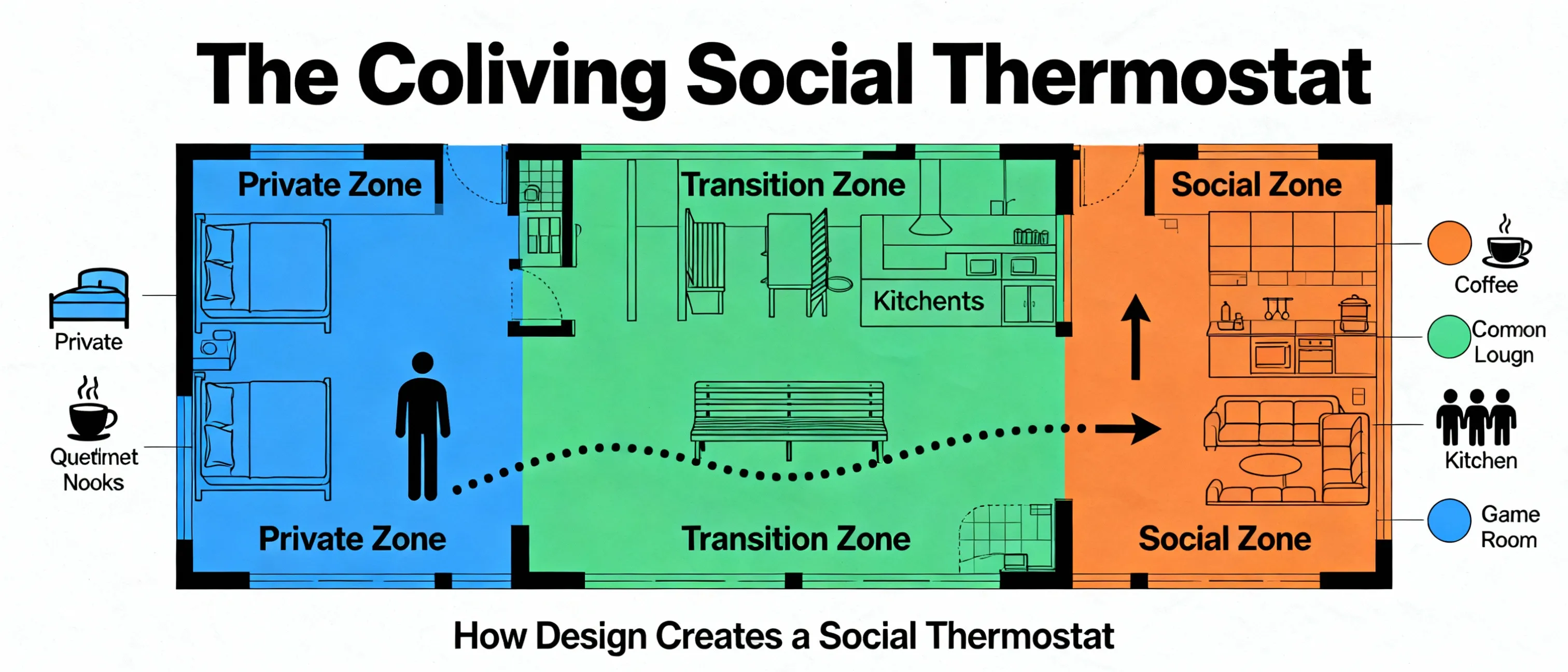
The most critical zone isn't the lounge or your bedroom—it's the in-between. Look for a building with a designed transition space, like a small bench or alcove outside clusters of bedrooms. This acts like a front porch, a semi-public spot for a low-commitment 5-minute chat or to read a book. It satisfies the human need for casual, glancing contact without the pressure to join a full common area scene, providing a crucial pressure release valve.
Acoustic Zoning: Managing Sound as an Invisible Boundary
True privacy is often about sound, not sight. Beyond bedroom soundproofing, examine the 'acoustic journey' of the building. Are noisy zones (kitchen, game room) buffered from quiet zones (reading nooks, phone booths) by a laundry room, bathroom block, or a hallway with a turn? This passive acoustic separation prevents the tension of 'sound bleed,' allowing late-night laughter in the kitchen to exist without invading the sanctity of the reading loft. It's design pre-solving a primary source of conflict.
Institutionalized Sanctuary: The Non-Negotiable Quiet Zone
Every common space cannot be multi-purpose. The most vital design feature is a dedicated, enforced 'library rules' zone—a room or enclosed area with no music, no group calls, and explicit signage. This isn't a flexible coworking lounge; it's a monastic retreat within the community. Its existence signals that pure, uninterrupted focus is a valued communal asset, not an antisocial act. It protects introverts and anyone on a deadline from having to negotiate for basic quiet.
The Alignment Profile
The environmental self-regulator: someone who intuitively reads spatial cues and uses different zones to manage their social energy. They appreciate that the building provides options, and they take responsibility for moving themselves to the right 'setting' for their current need.
The Misaligned Expectation
The belief that privacy is defined solely by a lockable door and that community happens only in scheduled events. If you expect to find deep solitude in a multi-use lounge or meaningful connection only in your bedroom hallway, you'll be constantly frustrated by the mismatch between your need and the space's designed function.
Good coliving design gives you the agency to choose your context throughout the day, trading the rigid control of a solo apartment for a curated menu of social environments. Does your ideal home provide you with places to be alone, together?